
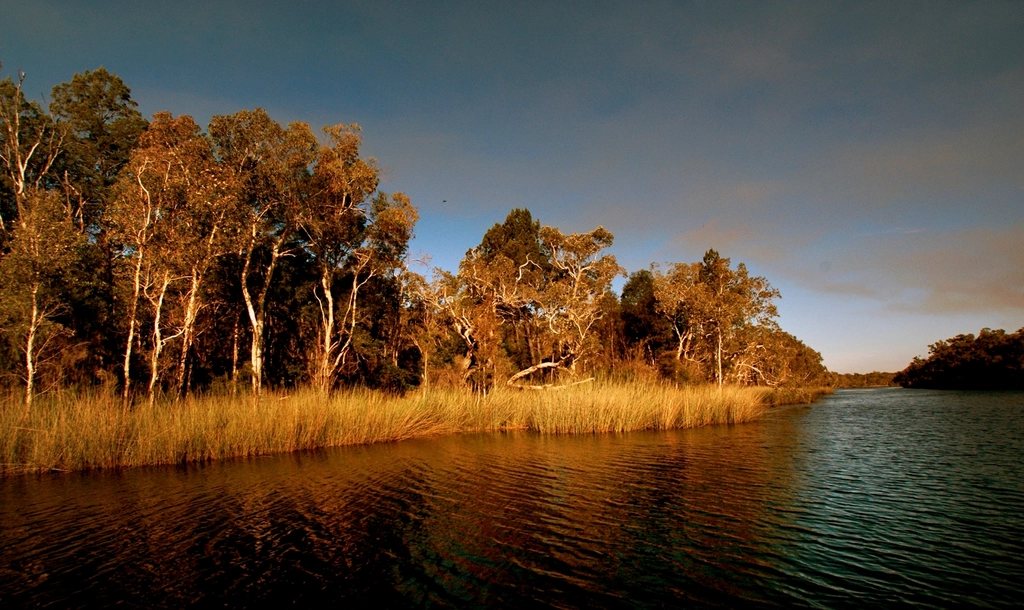
Most of the parks in this magazine are about going up. Congaree, in South Carolina, and the Everglades, at the bottom of Florida, are about going in. Both are essentially flat, both are wet for much of the year, and both reward a slow, attentive kind of walking that has nothing to do with summit views and everything to do with what is living within ten feet of the trail. If you have only ever hiked in the mountains, they will recalibrate your idea of what a great walk looks like.
Congaree: the tallest forest in the East
Congaree National Park protects the largest remaining tract of old-growth bottomland hardwood forest in the southeastern United States, about 26,000 acres (10,500 ha) of floodplain along the Congaree River, twenty miles southeast of Columbia. The numbers are hard to believe until you stand under the trees. Loblolly pines here reach 160 feet (49 m), among the tallest in eastern North America, and the park holds champion-sized specimens of a dozen species, from bald cypress and water tupelo to sweetgum and cherrybark oak. The canopy is one of the highest temperate deciduous canopies on Earth, and the forest floor floods, on average, about ten times a year when the river rises.
The place to start is the Boardwalk Loop, an elevated and then low boardwalk of roughly 2.5 miles (4 km) that leaves the visitor center, drops into the floodplain among the cypress knees, and circles past Weston Lake, an oxbow left behind by the river’s wandering. It is flat, wheelchair accessible, and takes about an hour and a half at the pace it deserves. Beyond it the dirt trails fan out through the forest: the Weston Lake Loop at 4.4 miles (7.1 km), the Oakridge Trail at 6.6 miles (10.6 km), and the King Snake Trail at 11.7 miles (18.8 km), the last of which runs through the quietest, most remote section of the park and is where we have seen barred owls, river otters and feral hogs in the same morning.
Reading the water at Congaree
The trails beyond the boardwalk are marked with numbered posts because the floodplain looks the same in every direction, and after a flood the paths can be under water or covered in fresh silt and debris. The park posts current conditions, and the rule of thumb is simple: when the river is high, stay on the boardwalk or paddle Cedar Creek instead. Entry to the park is free. Summer brings heat, humidity and mosquitoes measured on a famous six-point meter at the visitor center; late fall through early spring is the comfortable season. For about two weeks between mid-May and early June, a synchronous firefly display lights the forest after dark, and access on those evenings is managed by a lottery announced in general terms each spring.
The Everglades: a river you can walk across
Everglades National Park covers 1.5 million acres (600,000 ha) at the southern tip of Florida, and the landscape is a sheet of water a few inches deep and fifty miles wide moving south toward Florida Bay through sawgrass, cypress and hardwood hammocks. There is no high ground; the whole park lies within a few feet of sea level. Walking here means boardwalks over the sloughs, gravel paths along the pinelands, and, if you are game, wading through knee-deep water into a cypress dome with a ranger on a guided slough slog. The main road runs 38 miles (61 km) from the entrance near Homestead to Flamingo on Florida Bay, and the classic trails string along it.
The Anhinga Trail at Royal Palm, four miles in, is 0.8 miles (1.3 km) of paved path and boardwalk over a slough that never dries, which makes it the most reliable wildlife walk in any national park. In the dry season alligators, anhingas, herons, cormorants and turtles pack the water within arm’s reach of the rail. The adjacent Gumbo Limbo Trail, 0.4 miles (0.6 km), loops through a shady hardwood hammock. Further along, Pa-hay-okee is a short boardwalk to a raised platform over the sawgrass prairie, the “river of grass” itself, and Mahogany Hammock is a half-mile (0.8 km) boardwalk through a jungle-like island of mahogany trees with the largest specimen in the country.
Longer walks in the Everglades
For real mileage the options are limited but distinctive. The Long Pine Key area has about 22 miles (35 km) of connected fire roads and trails through pine rockland, dry and easy underfoot. Near Flamingo, the Snake Bight Trail runs 1.6 miles (2.6 km) each way through mangrove to a boardwalk over the bay’s mudflats, one of the best spots for flamingos and roseate spoonbills at low tide, and the Coastal Prairie Trail follows an old cotton-picking road for 7.5 miles (12 km) one way to Clubhouse Beach, where camping requires a backcountry permit. On the north side of the park, off the Tamiami Trail, Shark Valley offers a 15-mile (24 km) paved loop through the sawgrass with a 65-foot (20 m) observation tower at the far end, walkable in full, cycled by most, or taken by the park’s guided tram.
- Congaree Boardwalk Loop: 2.5 miles, flat, accessible, the best introduction to the floodplain.
- Congaree King Snake Trail: 11.7 miles, remote, closed when the river floods.
- Anhinga Trail: 0.8 miles, guaranteed wildlife, best from December to April.
- Shark Valley loop: 15 miles, paved, tower views across the river of grass.
When to go and what to expect
Both parks run on a wet-dry calendar rather than a hot-cold one. In the Everglades the dry season, roughly November to April, concentrates the wildlife around the remaining water and thins the mosquitoes; the wet season from May to October is hot, stormy, buggy and, at Flamingo especially, almost unbearable at dusk. Congaree has the same logic in a temperate key: the fall and winter months are dry, quiet and pleasant, while summer is for the boardwalk at dawn and nothing more. Neither park has bears to worry about in the Western sense, but the Everglades has alligators on every trail and, increasingly, invasive pythons, and the correct response to both is distance.
Bring water, since there is none you can drink on any of these trails, and bring insect repellent even in the dry months. Wear closed shoes on the dirt trails; the ground in Congaree is a tangle of roots and knees, and the Everglades limestone is sharp. Then slow down. On a mountain the reward comes at the top. Here it comes when you stop, and something you had not noticed slides quietly into the water beside you.
Read next: Best Hikes in Acadia National Park for Every Level of Hiker