
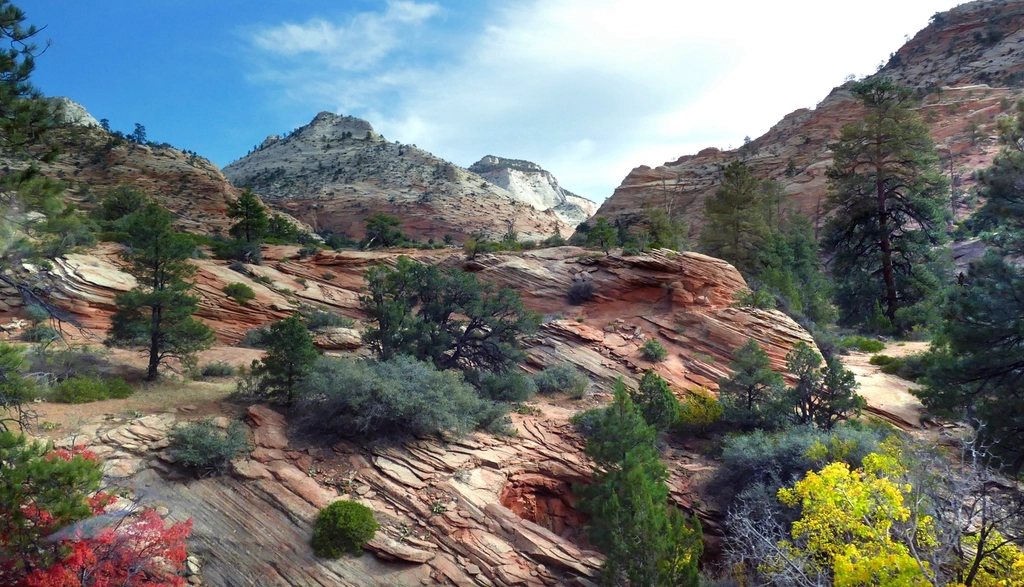
Leave No Trace was written for the backcountry, for the solo hiker deciding where to pitch a tent by an alpine lake. The parks we love now host a different reality: Great Smoky Mountains logs more than 12 million visits a year, and Zion, the Grand Canyon and Yosemite each see roughly 4 to 5 million, most of them concentrated on a few dozen miles of trail. The seven principles still hold, but crowds change which ones matter and how. What follows is our field version for busy parks, one principle at a time, with the specific behaviors that make the difference when there are 300 people on the same switchbacks.
Stay on the trail, even when it is muddy
The single largest impact in crowded parks is trail widening. When a puddle or a slow group blocks the path, the instinct is to step around, and a thousand people stepping around the same puddle turn a two-foot (60 cm) trail into a ten-foot (3 m) scar. Walk through the mud; that is what boots are for. On switchbacks, cutting the corner looks harmless and is the fastest way to start a gully that a storm turns into a trench. In the desert parks, the crust between the rocks is alive: cryptobiotic soil, a layer of cyanobacteria, lichen and moss that holds the ground together and takes decades to recover from a single footprint. If a trail crosses slickrock, follow the cairns the park built rather than adding your own, and never dismantle or move one.
Passing etiquette keeps the trail narrow too. Uphill hikers have the right of way; downhill hikers step to a durable spot, such as a rock, and let them by. On the Grand Canyon’s corridor trails, mule trains have priority over everyone: step to the uphill side, stand still, and follow the wrangler’s instructions until the last animal is past.
Waste: the problem the crowds made
Human waste is the issue rangers talk about most in the busiest parks, and toilet paper blooming beside popular trails is the most visible sign of it. In most backcountry the standard is a cathole 6 to 8 inches (15 to 20 cm) deep, at least 200 feet (60 m) from water, trails and camp, with toilet paper packed out rather than buried. In several high-use zones that standard is no longer enough, and the parks require carrying everything out in a sealable waste bag: the top-down Narrows and the Subway in Zion, the Mount Whitney corridor on the Sierra crest, and a growing list of canyon routes elsewhere. The bags are cheap, odor-proof and available at visitor centers; we carry one on any hike where the number of people exceeds the number of trees.
The rest of the waste rules are simple and widely ignored. Fruit peels, nut shells and apple cores are litter: they take months to break down in a dry climate and they train wildlife to work the trail. Use the toilets at trailheads before starting, because there will not be another one. Pack out what you pack in, including the twist tie and the little corner torn off the energy bar wrapper.
Wildlife: the food gap and the photograph gap
In crowded parks, wildlife problems come from two behaviors. The first is feeding, deliberate or not. Chipmunks and ground squirrels at popular viewpoints have learned that a hand in a pocket means food, and rock squirrels on the Grand Canyon rim bite more visitors each year than any other animal in the park. Drop nothing, feed nothing, and keep the pack closed when it is off your back. The second is distance: a crowd forms around an elk or a bear, each person edges a little closer than the last, and the animal ends up hemmed in against a road. We stay at the posted distances, 25 yards (23 m) for most animals and 100 yards (91 m) for bears, and we keep walking rather than joining the crowd, because a wildlife jam that is thinning is far safer for the animal than one that is growing.
Noise, speakers and the rest of the soundscape
The principle of being considerate of other visitors used to mean keeping camp quiet. It now mostly means speakers. A phone playing music from a pack pocket is audible for a quarter mile (400 m) on an open ridge and is among the most frequent complaints in park visitor surveys after crowding itself. Earbuds solve it completely, and one earbud out keeps you able to hear a bike, a bear or a hiker asking to pass. Drones have been prohibited in every national park, launching or landing, since 2014. Voices carry too; the trailside chat that feels normal at a pace of three miles an hour reaches everyone within earshot at a viewpoint where people came for silence. Yield the view after a few minutes, take the photograph and step back.
Leave what you find, including the cairn and the flower
Multiplied by a million visitors, small souvenirs empty a landscape. A wildflower picked on the Tioga Road, a piece of petrified wood, a shard of pottery in the Grand Canyon, a shell from Acadia’s beaches: each is protected by law and each disappears from a park one pocket at a time. Rock stacking has become the fashionable version of this: building cairns for photographs on a riverbank or a summit, which disturbs the habitat of small animals, confuses navigation for the people who rely on official cairns, and leaves a mark the next visitor copies. Take the photograph of the place as you found it, then leave it that way.
- Walk through mud and over rock; never around them.
- Carry a waste bag where required and pack out all toilet paper everywhere.
- Keep food sealed and pockets closed at viewpoints; feed nothing.
- No speakers; one earbud in, one out.
- Leave flowers, rocks, artifacts and cairns exactly as they are.
Timing as an ethic
The most effective Leave No Trace choice in a crowded park is not on the list: it is when you go. A trail carries the same number of boots either way, but a day spread from dawn to dusk erodes it less than the same day compressed into four hours, and it gives the animals a quiet window at the edges. Hiking at 6 a.m. or on a weekday, choosing the second-most-famous trail, or visiting in the shoulder season are all forms of consideration for the place and for the people who came for it. The parks are not too crowded to love; they are too crowded to be careless in.