
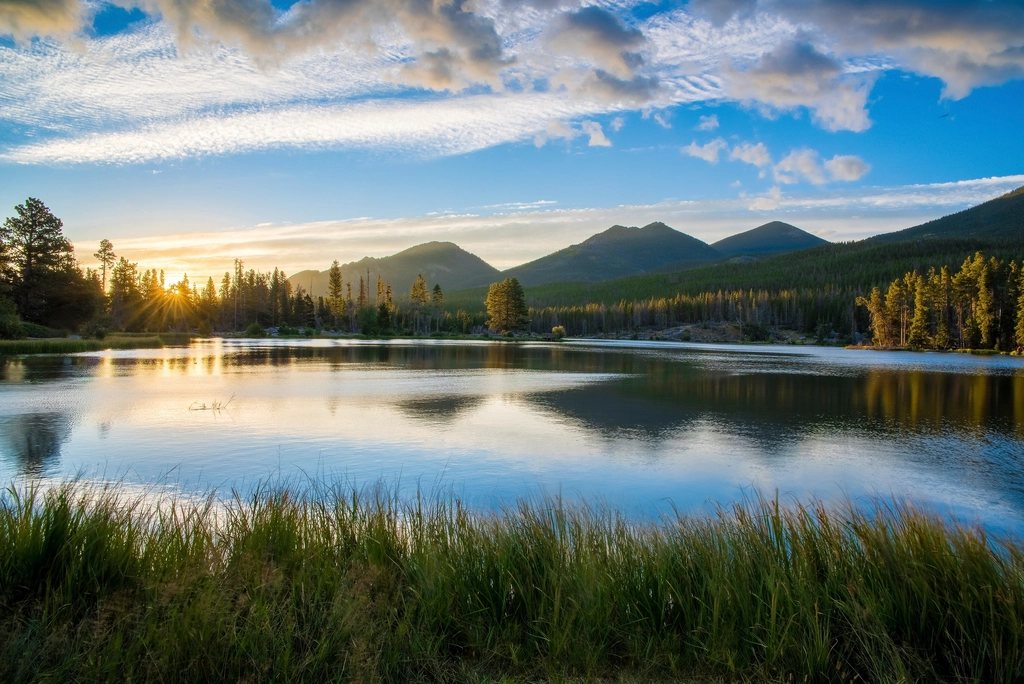
Rocky Mountain National Park, an hour and a half northwest of Denver, is where many Easterners first meet real altitude. The trailheads start around 9,000 feet (2,750 m), the summits top 14,000, and the thin air, the afternoon lightning and the sheer number of people all need managing. Two hikes define the place for us. Sky Pond is the best alpine day walk in the park, a lake tucked under granite spires at the head of a glacial valley. Longs Peak is the park’s one fourteener and the hardest thing most hikers will ever attempt without a rope. And because the park now controls access with a timed-entry reservation for most of the summer, we will explain how that system shapes both days.
Sky Pond: the valley of lakes
The walk begins at the Glacier Gorge trailhead on Bear Lake Road, at 9,240 feet (2,816 m). It is about 4.5 miles (7.2 km) one way to Sky Pond at 10,900 feet (3,322 m), a gain of roughly 1,700 feet (520 m), and the route is a staircase of destinations that lets weaker parties stop wherever they like. Alberta Falls comes first, less than a mile in. At the junction beyond it, keep right for Loch Vale; the left branch leads to Mills Lake and Black Lake in Glacier Gorge, an equally fine walk we save for a second day.
The Loch, at about 2.9 miles (4.7 km), is a long subalpine lake with the Cathedral Wall rising behind it, and it is where many people turn around. Above the Loch the trail climbs through the last of the trees to the base of Timberline Falls, and here the character changes. The route goes straight up beside the falls on wet, ledgy rock for about 100 feet (30 m), using hands, in what is a real scramble in the morning when the spray has frozen. Above it lies Lake of Glass, a shallow tarn on bare granite, and a final half mile of cairned slabs to Sky Pond itself, sitting in a cirque under the Sharkstooth and Taylor Peak with snow lying in the shadows through July. The round trip of 9 miles (14.5 km) takes five to seven hours, and the falls scramble is the reason to leave early: by noon it is a two-way queue.
Longs Peak and the Keyhole Route
Longs Peak stands 14,259 feet (4,346 m), the northernmost fourteener in the Rockies and the flat-topped block that dominates the view from Estes Park. The Keyhole Route is the only non-technical way up, and it is only non-technical for a few weeks in a good year, roughly mid-July to early September, when the upper mountain is free of snow and ice. It is 15 miles (24 km) round trip from the Longs Peak trailhead at 9,405 feet (2,867 m) with about 5,000 feet (1,525 m) of gain, and the park’s own description calls the upper half a climb, not a hike.
The first 6 miles are a steady trail through forest and tundra to the Boulder Field at 12,760 feet (3,890 m). From there you scramble up to the Keyhole, a notch in the ridge at about 13,200 feet, and pass through it onto the west side of the mountain, where the route follows painted bullseyes across the Ledges, up the long loose gully of the Trough, along the exposed shelf of the Narrows, and finally up the steep slabs of the Homestretch to the enormous flat summit. Every one of those sections has drops that would be fatal, and every one becomes far harder in wind, rain or snow. The standard plan is to leave the trailhead between 2 and 3 a.m. by headlamp, reach the Keyhole by sunrise, be on the summit by mid-morning and off the exposed sections before noon, when thunderstorms build almost daily. A party that is not at the Keyhole by about 7 a.m. should turn around. The full day takes 10 to 15 hours, and the descent is where most accidents happen.
The sensible alternative: Chasm Lake
The same trailhead offers a superb consolation. Chasm Lake sits at 11,760 feet (3,585 m) directly under the 900-foot (275 m) east face of Longs known as the Diamond, and the trail is 8.4 miles (13.5 km) round trip with 2,500 feet (760 m) of gain. The last stretch crosses a rock ledge that holds snow into July and needs care, but there is no real scrambling. From the lake you can watch climbers on the Diamond and, if you have started early, the sunrise light on the whole east face.
How timed entry works
From roughly late May to mid-October, the park requires a timed-entry reservation in addition to the entrance pass. There are two kinds. One covers the Bear Lake Road corridor, which includes the Glacier Gorge and Bear Lake trailheads, and applies for most of the day, from early morning to early evening. The other covers the rest of the park for the middle hours of the day only. Reservations are released in batches a month or so ahead, with a smaller share held back until the evening before, and they book a two-hour arrival window.
The practical consequences are these. For Sky Pond, either hold a Bear Lake corridor reservation or arrive at the entrance before the corridor window opens, which in practice means before 5 a.m., an hour that suits the hike anyway. A park-and-ride lot on Bear Lake Road with a free shuttle to the trailheads sidesteps the full parking lots. For Longs Peak, the alpine start solves everything: anyone leaving the trailhead at 3 a.m. is in the park long before any reservation window begins.
- Sky Pond: 9 miles round trip, 1,700 ft, scramble beside Timberline Falls, Bear Lake corridor reservation.
- Longs Peak Keyhole: 15 miles, 5,000 ft, mid-July to early September only, start by 3 a.m.
- Chasm Lake: 8.4 miles, 2,500 ft, under the east face of Longs, no scrambling.
- Emerald Lake from Bear Lake: 3.6 miles, 700 ft, the classic easy walk in the corridor.
Altitude, storms and the rest of the park
Flatlanders should spend a night or two around 8,000 feet before attempting anything above 12,000, drink more than feels necessary, and treat a headache or nausea as a reason to descend rather than push on. Thunderstorms are the park’s real hazard; they build over the peaks most summer afternoons, and being above treeline after 1 p.m. is a gamble we do not take. Trail Ridge Road, the 48-mile (77 km) highway across the park that reaches 12,183 feet (3,713 m), the highest continuous paved road in the country, opens around Memorial Day and closes with the first big October storms,. Elk bugle in the meadows in late September, the aspens turn gold, and that is when we would choose to come.