
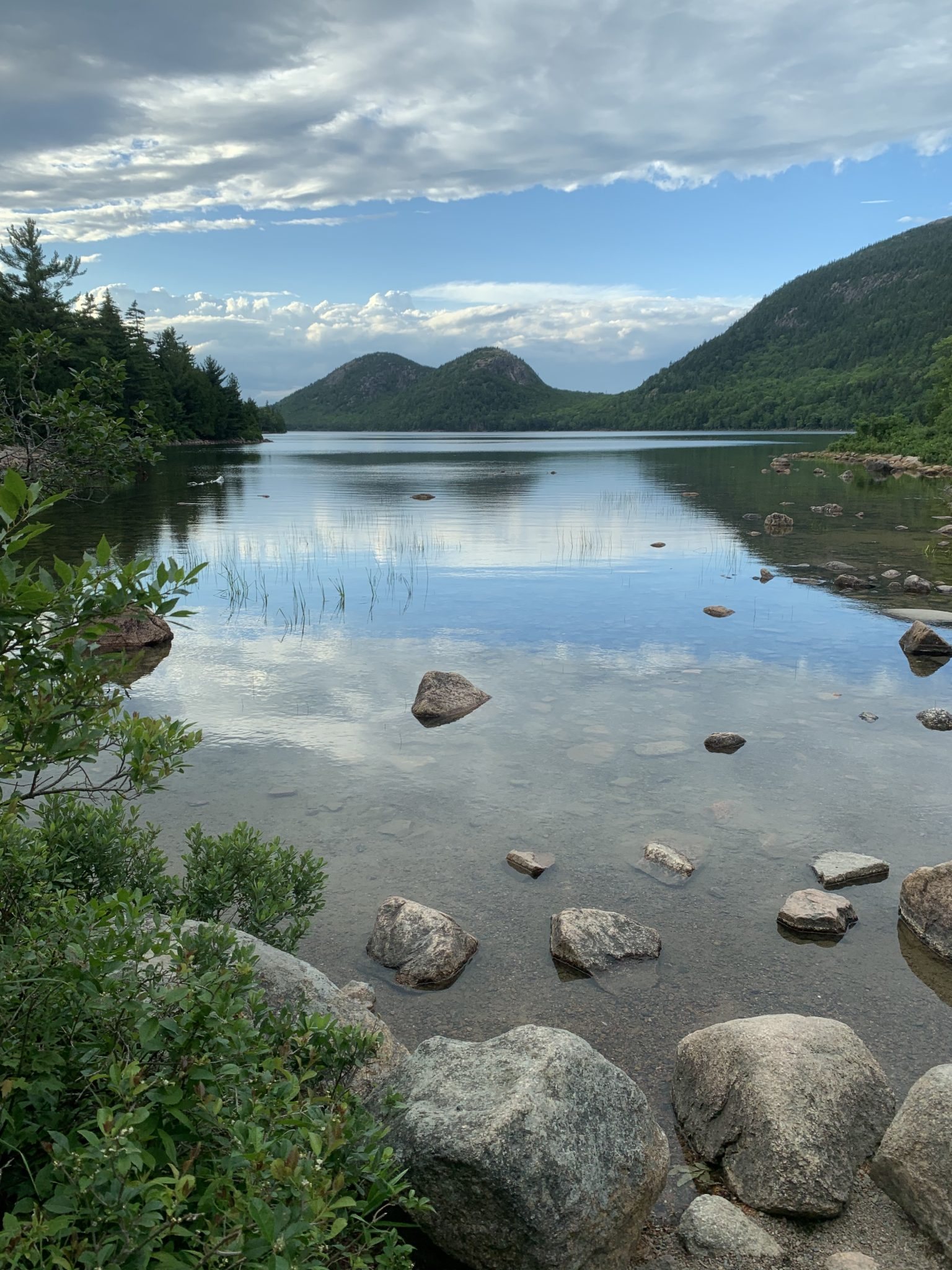
Acadia is the smallest of the big-name parks we cover, and it may be the one that packs the most into a single long day. On Mount Desert Island, off the coast of Maine, granite domes rise straight out of the Atlantic, and the park’s trail builders of the early twentieth century decided the sensible thing to do was to bolt iron rungs and ladders into the cliffs so that walkers could go straight up them. The result is a handful of short climbs that feel far bigger than their mileage suggests, and a summit road that lets you watch the sun come up over the ocean before most of the island has had its first coffee.
Cadillac Mountain: the first light in the country
Cadillac Mountain tops out at 1,530 feet (466 m), which makes it the highest point on the Atlantic coast of the United States. From roughly early October to early March, its summit is the first place in the country to see the sunrise, and even in summer the view east over Frenchman Bay and the Porcupine Islands is the reason people set alarms for 4 a.m. A paved 3.5-mile (5.6 km) road winds to the top, and in the busy season the park runs a vehicle reservation system for it: you book a timed window in advance, and sunrise slots go quickly. We treat the reservation as part of the plan rather than an afterthought, and we always have a backup in case we miss the booking window.
If you would rather earn it, the Cadillac North Ridge Trail climbs 2.2 miles (3.5 km) one way from the Park Loop Road, gaining about 1,100 feet (335 m) over open granite with views the whole way. The South Ridge Trail is longer, 3.5 miles (5.6 km) one way from Route 3, and quieter. Either way, bring a real jacket. The summit is exposed, the wind off the water is cold even in July, and the sunrise crowd standing in shorts is always shivering by the time the sun clears the horizon.
The Precipice: a ladder up a cliff
The Precipice Trail is the most famous of Acadia’s rung-and-ladder routes and the one that deserves the most respect. It climbs the east face of Champlain Mountain, 1,058 feet (322 m), gaining roughly 1,000 feet in about 0.9 miles (1.4 km). That ratio tells you everything: this is a near-vertical route with iron rungs, handrails, narrow ledges and a few sections where you are clearly on a cliff with nothing much below your heels. It is not a technical climb, and no ropes are involved, but it is a genuine scramble with exposure, and the park is blunt that it is not for small children, dogs, or anyone uncomfortable with heights.
Two practical points. First, the trail is closed for most of the spring and summer, typically from March into August, while peregrine falcons nest on the cliff. The park posts the reopening once the chicks have fledged, so late summer and fall are the reliable windows. Second, do not descend the Precipice. Everyone goes up it, and coming down rungs while others are climbing is both slow and unsafe. The standard loop is up the Precipice, then down the Champlain North Ridge Trail and back along the Orange and Black Path to the trailhead, about 2.5 miles (4 km) in total. Allow two to three hours; the summit views over Frenchman Bay are the best on the island after Cadillac.
The Beehive: the same thrill in miniature
If the Precipice is closed, or if you want to test your head for heights before committing to it, the Beehive is the answer. It rises just 520 feet (158 m) above Sand Beach, and the rung-assisted climb is only about 0.4 miles (0.6 km) of the 1.4-mile (2.3 km) loop, but it packs in iron ladders, a walk along a ledge with a handrail, and a view straight down onto the beach and Great Head. The crux is short and honest. Children who are comfortable on climbing frames often love it; adults who dislike exposure often turn around at the first rung, and there is no shame in that.
As with the Precipice, the etiquette is up only. The descent follows the Bowl Trail past a small pond of the same name, a lovely place to sit before rejoining the crowds at Sand Beach. Start early: the Sand Beach parking area fills by mid-morning in summer, and the Beehive is a slow-moving queue by noon. The free seasonal shuttle that runs around the island solves the parking problem entirely, and we now use it almost every time.
Stringing the three together
Because everything sits along the eastern side of the Park Loop Road, a full day writes itself. Cadillac for sunrise, breakfast in the car or on the summit, then drive or shuttle down to Sand Beach for the Beehive while the rock is still cool. Walk the Ocean Path past Thunder Hole and Otter Cliff, about 2 miles (3.2 km) of flat coastal trail, to stretch out the legs. Then, if the season allows, the Precipice in the afternoon when the east-facing cliff is in shade. That is roughly 7 miles (11 km) of walking with about 2,500 feet (760 m) of ascent, and it covers the three most dramatic bits of the park in one loop.
- Cadillac sunrise: 1,530 ft summit, timed vehicle reservation in season, warm layers essential.
- Beehive loop: 1.4 miles, 520 ft of gain, iron rungs, descend by the Bowl Trail.
- Precipice loop: 2.5 miles, 1,000 ft of gain, closed for falcon nesting until late summer.
- Ocean Path: 2 miles one way, flat, the best link between Sand Beach and Otter Point.
Weather, rock and timing
Acadia’s granite is superb when dry and treacherous when wet. Rain, sea fog, and the lichen that grows on shaded faces turn the rung trails into something we simply do not do. If the forecast is damp, swap the cliffs for Gorham Mountain or the carriage roads and come back another day. Fog is common in early summer, and September and early October are the dry, clear months that locals rate above all others, with the added bonus of fall color across the island’s maples and birches by the second week of October.
Finally, the crowds. Acadia sees around four million visits a year on an island smaller than many city suburbs. The park’s answer is the summit reservation, the shuttle, and an entrance pass sold in advance. Ours is simpler: be on the trail at dawn, and be off the popular routes by the time the day-trippers arrive. On these particular climbs, that habit is as much about safety as it is about solitude.