
Every summer the parks record the same incidents: a visitor tossed by a bison in Yellowstone, an elk charging a photographer on a lawn during the rut, a black bear peeling open a car in Yosemite for a bag of chips. Almost none of these end in a fatality, and almost all of them were preventable by a few yards of distance or a closed food locker. The rules are not complicated, but they differ between species and between parks, so we keep them straight here: how far to stay from what, where food has to go at night, and when bear spray is worth carrying.
The distances the parks enforce
Yellowstone’s regulation, which has become the standard across the system, is 25 yards (23 m) from bison, elk, moose, bighorn sheep and all other wildlife, and 100 yards (91 m) from bears and wolves. Those are minimums, not suggestions, and they apply on boardwalks, in campgrounds and from car windows. A quick way to check without a tape measure: hold your thumb at arm’s length; if it does not fully cover the animal, you are too close to a bison or elk. Some parks post 50 yards (46 m) for bears in areas with black bears only, but we treat 100 yards as the floor everywhere, because the animal, not the sign, decides when it feels crowded.
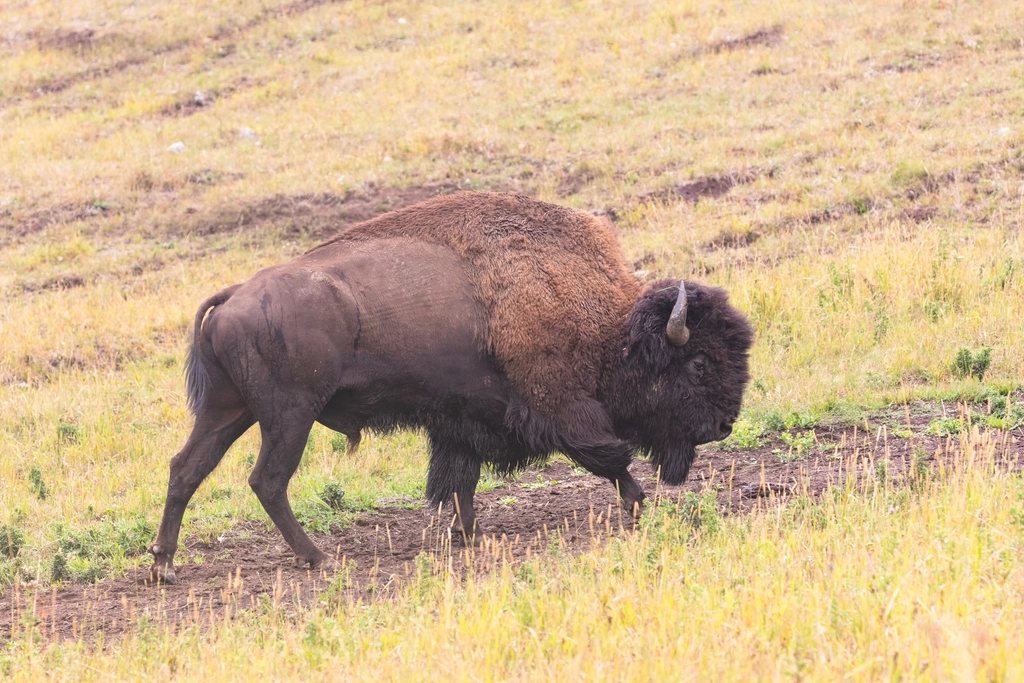
Bison deserve special respect because they look slow. An adult bull weighs up to 2,000 pounds (900 kg), can run 35 miles per hour (56 km/h), and can turn far faster than a person. They injure more visitors in Yellowstone than any other animal, and the typical victim was within 10 feet (3 m) taking a photograph. A raised tail, pawing, or a head swing toward you means the encounter is already over and you should be moving away, slowly and without turning your back.
Elk in the rut and moose on the trail
Elk are placid for ten months of the year and a different animal in September and October. Bulls in the rut bugle, herd their cows and charge anything that looks like a rival, including people, cars and tripods. The meadows around Mammoth Hot Springs in Yellowstone and the town lawns near Rocky Mountain National Park’s east entrance are the classic hazard zones, and both parks post rangers to keep visitors back. In late spring, cow elk with newborn calves are just as dangerous; they hide calves in vegetation near roads and trails and defend them without warning. Moose, present in Rocky Mountain, Yellowstone and Glacier, are the animal seasoned rangers respect most: unpredictable, huge, and willing to charge a dog on a leash. Give them the road.
Black bears and grizzlies: know which park you are in
Only two of the parks we cover have grizzly bears: Yellowstone and Glacier, along with the wilderness around them. Yosemite, Zion, the Grand Canyon, Olympic, Acadia and the Smokies have black bears only, and the Smokies have one of the densest populations in the East, roughly two bears per square mile (about 0.8 per square kilometer). The distinction matters for behavior, not for distance. A black bear that makes contact is usually testing or food-motivated: make yourself large, make noise, fight back if it comes to that. A grizzly that charges is usually defending cubs, a carcass or its space: stand your ground, deploy spray if you have it, and if contact is made, lie face down with hands over your neck and stay still until it leaves.
Hiking in groups of three or more, talking on blind corners and near loud water, and avoiding dawn and dusk on brushy trails remove most of the risk of a surprise encounter. Surprises are the problem; a bear that sees you coming at 200 yards (180 m) almost always leaves.
Food storage rules by park
Food storage is where the parks are strictest, and for good reason: a bear that learns to associate people with food usually ends up destroyed. Rules vary, so we check the current ones for each park before arrival, but the pattern holds. In Yosemite, every campsite and most trailhead parking areas have steel food lockers, and anything with a scent, including toiletries, empty coolers and a child’s car seat with crumbs, must be in a locker rather than a vehicle overnight. Bear canisters are required for overnight wilderness trips throughout the park. Yellowstone and Glacier campgrounds require food, garbage and cooking gear to be in a hard-sided vehicle or locker whenever unattended, and backcountry sites have food poles or lockers. Great Smoky Mountains backcountry sites use cable systems for hanging packs. In the Grand Canyon’s inner canyon, the pests are ravens, squirrels and ringtails rather than bears, and the metal storage boxes at campsites exist for them.
- Nothing with a scent stays in a tent: food, wrappers, sunscreen, lip balm, toothpaste.
- Cook and eat away from where you sleep in the backcountry, ideally 100 yards (91 m).
- Pack out every scrap; a fruit peel or a spilled handful of trail mix teaches a bear as well as a full cooler.
- Close lockers and dumpsters fully; the latches are bear-proof only when engaged.
Bear spray: where it helps and where it is banned
Bear spray is a capsaicin aerosol that produces a cloud reaching about 25 to 30 feet (8 to 9 m) for six to nine seconds. A study of encounters in Alaska found it stopped undesirable bear behavior in more than 90 percent of cases, a better record than firearms. We carry it in grizzly country, which means Yellowstone and Glacier, and we carry it on the hip or chest strap, never in the pack, because a charging bear covers 100 yards in about six seconds. Practice pulling the safety clip; almost no one manages it smoothly the first time.
Two things surprise visitors. First, spray cannot fly in checked or carry-on baggage, so it has to be bought or rented near the park and left behind at the end of the trip. Second, some parks ban it outright: Yosemite classifies bear spray as a weapon and prohibits possession, and it is unnecessary there in any case. It is also not a repellent; spraying it on a tent or a pack attracts rather than deters. Use it only on an approaching bear, aimed slightly downward so the cloud rises into its path.
The habit that covers everything
If we had to reduce all of this to one habit, it would be this: stop moving toward the animal. Nearly every injury in the incident reports involves a person closing distance for a better view or a better photograph. A long lens, a pair of binoculars, and the willingness to wait rather than approach turn a dangerous encounter into the kind of sighting that becomes the best story of the trip.