
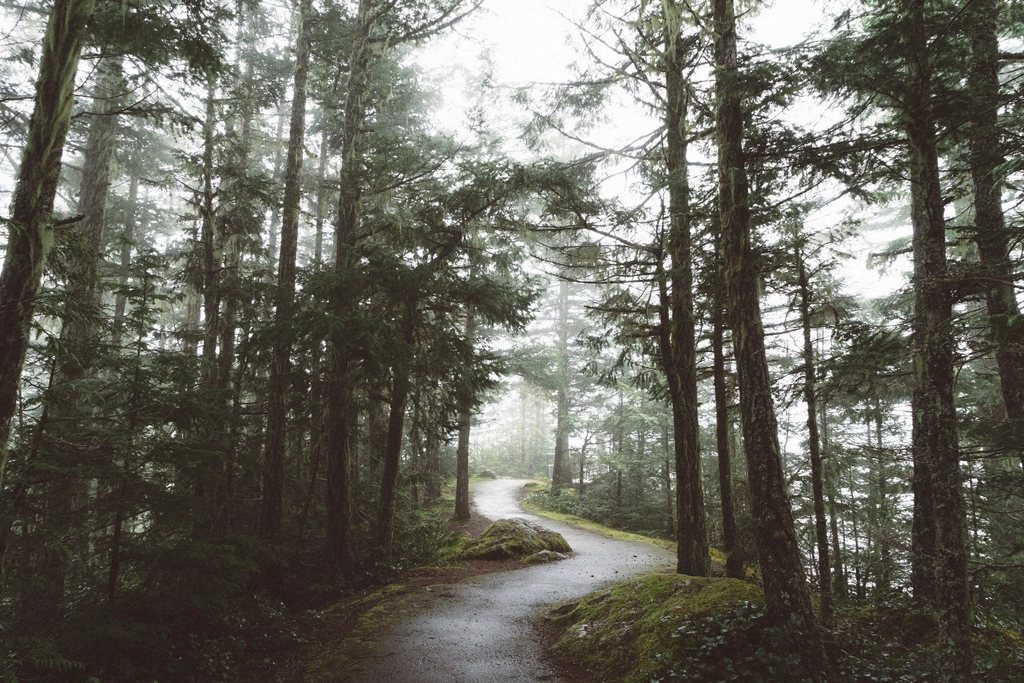
Olympic National Park is really three parks wearing one name. On the north side, subalpine ridges look across the Strait of Juan de Fuca to Canada. On the west, the wettest forest in the contiguous United States drips under trees that were seedlings before Europeans reached this coast. And along the Pacific, 73 miles (117 km) of roadless shoreline hold sea stacks, tide pools and driftwood the size of school buses. No road crosses the park’s interior, so seeing all three means driving around the peninsula. We think it is worth every mile, and here is how to hike the best of each.
Hurricane Ridge: the mountains without the sweat
From Port Angeles, a paved road climbs 17 miles (27 km) to Hurricane Ridge at 5,242 feet (1,598 m), the easiest high-country access anywhere in the park. Step out of the car and the Olympic Mountains fill the southern sky, with the glaciers of Mount Olympus, 7,980 feet (2,432 m), visible on a clear day. Black-tailed deer graze the meadows beside the parking lot, and in July the slopes are purple with lupine. The historic day lodge burned in 2023 and services on the ridge remain limited, so bring everything you need, including water.
The classic walk is Hurricane Hill, 3.2 miles (5.1 km) round trip on a partly paved path that gains about 700 feet (210 m) to a 5,757-foot (1,755 m) summit with a 360-degree view: the Olympics behind you, the strait, Vancouver Island and, on the clearest days, Mount Baker ahead. Marmots whistle from the rocks, and the last quarter mile is the steepest. For a bigger day, the Klahhane Ridge route via the Switchback Trail climbs more than 1,500 feet (460 m) to a knife-edge ridge where mountain goats have been seen for decades. The road usually opens fully in late spring and closes to daily traffic once the snow arrives in autumn; in winter it opens on weekends for snowshoeing when conditions allow.
The Hoh Rainforest: walking inside the green
An hour and a half of driving west and south brings you to the Hoh River valley, where 12 to 14 feet (3.7 to 4.3 m) of rain fall in an average year. The result is a temperate rainforest of Sitka spruce and western hemlock 250 feet (76 m) tall, bigleaf maples so thick with club moss that their limbs sag under the weight, and a forest floor of ferns, fallen nurse logs and oxalis that never seems to see direct sun. Roosevelt elk, the largest elk in North America, browse the bottomlands and are often seen from the trail in the early morning.
Two short loops from the visitor center are the perfect introduction. The Hall of Mosses, 0.8 miles (1.3 km), passes through the most photographed maple grove in the park; the Spruce Nature Trail, 1.2 miles (1.9 km), drops to the milky glacial river. Walk them slowly and in the rain if you can, because that is when the forest is at its best. For a real hike, the Hoh River Trail runs 17.3 miles (28 km) up the valley to Glacier Meadows below the Blue Glacier on Mount Olympus. The first 5 miles (8 km) to Five Mile Island are nearly flat and make an ideal out-and-back day walk through old growth; the upper valley is a two- or three-day backpack that requires a wilderness permit and a bear canister.
The coastal strip: tides, headlands and sea stacks
The third Olympic is the Pacific coast, and hiking here follows different rules. The beaches are the trail, and the tide decides when you can walk them. Several headlands can only be rounded at low tide, and a rising sea can trap you against cliffs with no way out, so every walk longer than a stroll starts with a tide table and a watch. Where headlands cannot be rounded at all, short overland trails climb over them, marked at each end with round orange-and-black targets on the trees; some involve fixed ropes on muddy slopes.
The easiest introductions are the beaches near La Push and Kalaloch. Rialto Beach is a walk along cobbles and driftwood to Hole-in-the-Wall, a sea arch 1.5 miles (2.4 km) north of the parking area, with tide pools full of anemones and sea stars on the far side at low water. Second Beach, reached by a 0.7-mile (1.1 km) forest trail that drops through the trees, is a broad crescent of sand framed by sea stacks and a natural arch; Third Beach is a longer 1.4-mile (2.3 km) walk to a wilder cove. Farther south, Ruby Beach is famous for its garnet-tinted sand and offshore rocks, and it is the best of the Kalaloch beaches for a sunset.
The Ozette Triangle
For the full coastal experience in a single day, drive to Lake Ozette in the far northwest of the peninsula and walk the Ozette Triangle. Two legs of cedar boardwalk, each about 3 miles (5 km), lead through bog and coastal forest to Cape Alava, the westernmost point in the contiguous United States, and to Sand Point. Between them, 3 miles (5 km) of beach, sea stacks and tide pools link the two, passing the Wedding Rocks petroglyphs carved by the Makah people centuries ago. The loop is about 9.4 miles (15 km) with little elevation gain but slow, uneven walking on the beach; plan around a low tide for the middle section. Sea otters, bald eagles and gray whales are all regular sightings, and the camping at Cape Alava is a wonderful first coastal backpack.
Planning across the three parks
- Hurricane Hill: 3.2 miles (5.1 km) round trip, 700 feet (210 m) of gain, 1.5 to 2.5 hours; best from July to early October.
- Hoh River Trail to Five Mile Island: 10 miles (16 km) round trip, nearly flat, 4 to 5 hours; walkable year round, muddiest in winter.
- Rialto Beach to Hole-in-the-Wall: 3 miles (4.8 km) round trip, best within two hours of low tide.
- Ozette Triangle: 9.4 miles (15 km) loop, 5 to 7 hours; check the tide for the beach leg.
- Overnights anywhere in the park’s wilderness, including the coast, require a permit reserved in advance and a hard-sided food canister; raccoons, not bears, are the coastal thieves.
The weather is the one constant across all three landscapes: it changes fast, it is often wet, and it is rarely warm. Pack a real rain shell, wool layers and a dry change of clothes in the car, and Olympic will feel less like a challenge and more like the privilege it is.