
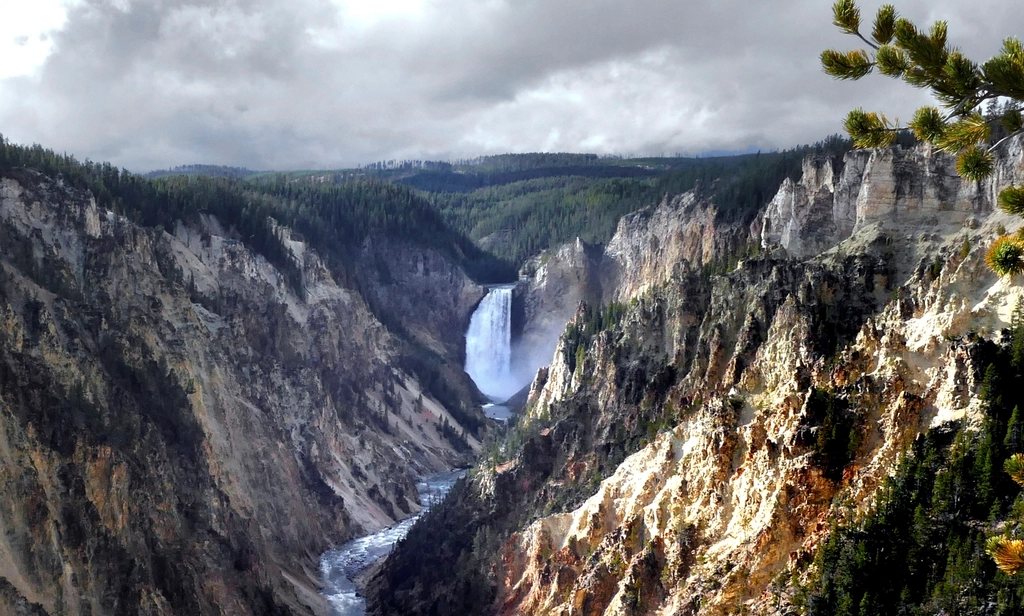
Most visitors experience Yellowstone through a windshield, and the park’s road loop makes that easy. But the moment you step more than a few hundred yards from the pavement, Yellowstone changes character: the crowds vanish, the wildlife stops being a traffic jam and starts being an encounter, and the scale of the place becomes real. This is our guide to two of the finest day hikes in the park, the summit of Mount Washburn and the walk to Fairy Falls, plus the ground rules for moving through the geyser basins that make Yellowstone unlike anywhere else on Earth.
Mount Washburn: the best summit for the effort
Mount Washburn rises to 10,243 feet (3,122 m) between Canyon and Tower, and it is the one high peak in Yellowstone that almost any reasonably fit hiker can reach on a well-graded trail. Two routes climb it. From the Dunraven Pass trailhead on the Grand Loop Road, the trail is about 6.8 miles (11 km) round trip with roughly 1,400 feet (430 m) of gain, following an old road bed in long, gentle switchbacks through whitebark pine and open meadow. From the Chittenden Road parking area on the north side, the route is a little shorter and a little steeper, around 5 to 6 miles (8 to 10 km) round trip, and it is the one to choose if the Dunraven lot is full, which it often is by mid-morning.
The summit holds a working fire lookout with an enclosed viewing room, and the panorama is enormous: the Absaroka Range to the east, the Grand Canyon of the Yellowstone below, the Tetons on a clear day far to the south, and the whole caldera spread out like a map. Bighorn sheep are almost a fixture on the upper slopes in summer, and grizzlies use the meadows in early season, so bear spray belongs on your hip. The trail typically opens once the snow melts off the upper switchbacks, usually late June or early July, and it holds wildflowers through August. Wind on the summit can be ferocious even in July; pack a shell and a hat that will not blow off.
Fairy Falls and the Grand Prismatic overlook
At the other end of the effort scale, the Fairy Falls trail south of Midway Geyser Basin is a nearly flat walk that combines two of the park’s showpieces. From the trailhead, a steel bridge crosses the Firehole River and the old freight road runs along the edge of the basin. After about 0.6 miles (1 km) a signed spur climbs a hillside for 105 feet (32 m) to the Grand Prismatic overlook. From the boardwalk, Grand Prismatic Spring is a wall of steam with a hint of color; from up here it becomes the picture everyone knows, a 370-foot (113 m) disc of deep blue ringed with orange and yellow bacterial mats, the third-largest hot spring in the world.
Back on the main trail, another 1.6 miles (2.6 km) through young lodgepole forest, regrown since the fires of 1988, brings you to Fairy Falls, a slender 197-foot (60 m) ribbon of water dropping off the Madison Plateau into a mossy amphitheater. Round trip from the trailhead is about 5 miles (8 km) with negligible elevation change. If you have another hour, continue 0.7 miles (1.1 km) beyond the falls to Imperial Geyser, a blue pool in a meadow that bubbles and splashes almost constantly, with Spray Geyser puttering beside the trail on the way. Note that the trailhead sits inside a bear management area and is closed every spring until late May.
The thermal basins: why the rules exist
Yellowstone contains more than 10,000 thermal features and about half of the world’s active geysers, and the ground around them is not ground in the usual sense. A thin, brittle crust of silica or travertine often sits over scalding water, and it can look solid, dry and even grassy right up to the moment it breaks. Hot spring water in the basins is frequently at or near the boiling point, which at this elevation is around 199 degrees Fahrenheit (93 C), and it is often acidic. More than twenty people have died in Yellowstone’s thermal areas, nearly all of them after leaving the boardwalk or trail. The rules are not about protecting the features from you; they are about protecting you from the features.
Boardwalk etiquette that actually matters
Stay on the boardwalks and marked trails, without exception, and keep children within arm’s reach. Do not touch the water, dip a finger to test it or fill a bottle; even the runoff channels can burn. Never throw coins, rocks or anything else into a spring or geyser: objects clog the plumbing and have permanently damaged several features over the years. Pets are not allowed in the basins at all. Hats, phones and sunglasses that blow off a boardwalk stay where they land; retrieving them is how people get hurt. Drones are banned throughout the park. And give the bison the right of way when they wander through the basins, as they do most days at Old Faithful and Midway, keeping at least 25 yards (23 m) from them and 100 yards (90 m) from bears and wolves.
Reading the basins like a hiker
Treat the basin boardwalks as trails in their own right, because the best ones are real walks. The Upper Geyser Basin at Old Faithful has around 5 miles (8 km) of paths and boardwalks linking dozens of geysers; a loop out to Morning Glory Pool and back takes a couple of hours, and the eruption predictions posted at the visitor center let you time it around Grand, Castle, Riverside and Daisy as well as Old Faithful, which erupts roughly every 60 to 110 minutes. Norris Geyser Basin, the hottest and most changeable in the park, has two loops totaling about 3 miles (5 km) across a bleached, hissing plain that feels like another planet. Mammoth Hot Springs offers a stair-stepped climb through travertine terraces. Go early or late in the day: the steam is thickest in cool air, the light is low and colored, and the boardwalks are quiet.
- Mount Washburn from Dunraven Pass: 6.8 miles (11 km) round trip, 1,400 feet (430 m) of gain, 3 to 5 hours; usually open late June to early October.
- Fairy Falls with the overlook: about 5 miles (8 km) round trip, nearly flat, 2 to 3 hours; add 1.4 miles (2.3 km) for Imperial Geyser.
- Upper Geyser Basin full loop: up to 5 miles (8 km) of boardwalk and trail, 2 to 3 hours depending on eruption timing.
- Always: bear spray, water, sun protection, and a firm rule that nobody leaves the boardwalk.
Yellowstone rewards patience more than mileage. Climb Washburn for the view, walk to Fairy Falls for the quiet, and then spend an evening on the boardwalks watching the earth breathe. It is the closest thing to walking through a living geology lesson that we know.
Read next: Utah's Big 5 National Parks: What They Are and How to Plan a Trip